Utah’s campaign to repeal Prop. 4, the voter-approved anti-gerrymandering initiative that created an independent redistricting commission, dumped a mountain of signatures at the last minute on Sunday, likely clearing the statewide bar. The catch is the map: to qualify for November’s ballot, organizers still need verified signatures from 8% of registered voters in 26 of 29 Senate districts. Opponents are trying to peel names off petitions, which is drawing pushback from national Republicans telling Utahns to “just say NO!”
How did organizers get so many signatures at the last minute?
The eleventh‑hour flood sparked chatter that organizers were “sandbagging” by sitting on packets until the buzzer or worse—that the signatures could be fraudulent.
Here’s the boring (and relevant) truth: a packet has 30 days from its first signature to be submitted. Plenty of packets that started weeks ago only came in on Sunday. That looks like a surge—without proving shady timing.
GOP Chairman Rob Axson, who leads Utahns for Representative Government (UFRG), says they weren’t “sandbagging.”
“Campaigns are always meant to be a crescendo,” Axson says, adding that it’s very labor-intensive to distribute and then collect signature packets from across the state.
The last-day surge looks even stranger alongside UFRG’s bid to have the Utah Supreme Court extend the deadline from Sunday to Tuesday.
Axson says they went to court for two reasons: alleged interference with the petition drive and confusion over a weekend deadline.
“There were some important things we felt we needed to raise while they were still open issues,” Axson said. “The violence we experienced, for example.”
UFRG alleges roughly 300 signatures were stolen or destroyed and that at least 50 circulators quit amid threats and harassment.
They also argue Utah’s practice is to roll weekend deadlines to the next business day. “Custom in Utah had always been to have a deadline reflected next ‘business day’ when falling on a weekend or holiday. Our ask for Tuesday was honoring that,” Axson said. He added, “We assumed the court would reject [our petition], but for those reasons we still felt it important to raise the question.”
Could the last-minute court gambit be an attempt to set up a lawsuit should the initiative fail to secure enough signatures to qualify for the ballot? Losing initiative campaigns in Utah routinely sue to extend deadlines, force acceptance of signatures, or reverse rejections.
Axson denies this was about setting up future litigation.
“Our position is that the deadline should have always been the next business day. That was the request we were making,” Axson says.
He also says they wanted to keep the spotlight on the harassment and violence toward signature gatherers.
“I, for one, pray that the violence and intimidation tactics stop in Utah! I don’t care what side of an issue or end of the political spectrum. There is no room for that. Raising those elements on the record hopefully will contribute to Utah being free of that.”
How many signatures did they turn in on Sunday?
Axson says the final signature tally from his group is “tens of thousands of signatures” toward the 200,000 raw‑signature mark. Not all of those came in on Sunday.
As of Friday, 88,948 signatures were verified—about 63% of the statewide target. That left 51,800 to go.
Barring a signature-verification catastrophe, Sunday’s haul likely means UFRG will comfortably clear the statewide bar. At a 75% acceptance rate, netting 51,800 verified signatures would take roughly 70,000 raw signatures; the campaign says Sunday’s drop exceeded that.
Verification lags by several days. Assuming 15,000-20,000 raw signatures are already in the pipeline, Sunday’s push looks like an additional 60,000 to 130,000 raw signatures, leaving roughly ~75,000-150,000 still to be processed.
Axson says he still doesn’t know Sunday’s exact total because the final push overshot expectations.
“We could have gathered another 100K beyond that but had stopped gathering in most of the state a long time ago to ensure that the numbers were gathered and turned in from the locations needed to exceed all the requirements,” Axson said.
“I could have turned in 350K if we wanted to just make the point of the total number, but we wanted to engage in every district and far exceed all the requirements with what we turned in.”
Assuming 75% acceptance, that pipeline translates to ~45,000-113,000 verified—enough to push them past the statewide mark.
Geography is the biggest hurdle
To qualify for the ballot, organizers need both the statewide total and verified signatures from 8% of registered voters in 26 of 29 Senate districts.
As of Friday, they’d cleared the bar in just four districts. They need 22 more and can only miss in three.
The 25 districts still under the line need 55,648 more verified signatures, total.
If Sunday’s dump plus the assumed pipeline nets ~100,000 verified signatures, that’s an average of ~4,000 in each of the 25 lagging districts—enough to carry most of them across the finish line.
Those remaining signatures won’t be evenly distributed, though.
Five Senate districts still need 3,000+ verified signatures to hit the threshold:
- SD14 still needs 4,190 signatures
- SD7 still needs 3,546 signatures
- SD17 still needs 3,338 signatures
- SD19 still needs 3,235 signatures
- SD8 still needs 3,042 signatures
County clerks have 21 days from the day that signatures are submitted to verify them. The final day for signature verification is March 7.
Signature removal will be a huge factor in success or failure
Opponents are contacting signers to yank their names from the petitions. Approximately 1,200 Utahns erased their names from the list between Jan. 23 and Feb. 13, including 727 on Friday alone.
That effort will continue as opponents have 45 days from the day that a petition signer’s name is posted online to have it removed.
On Monday, a mass text from the Republican National Committee on behalf of UFRG seemingly aimed at the signature rescission effort went out to Utahns.
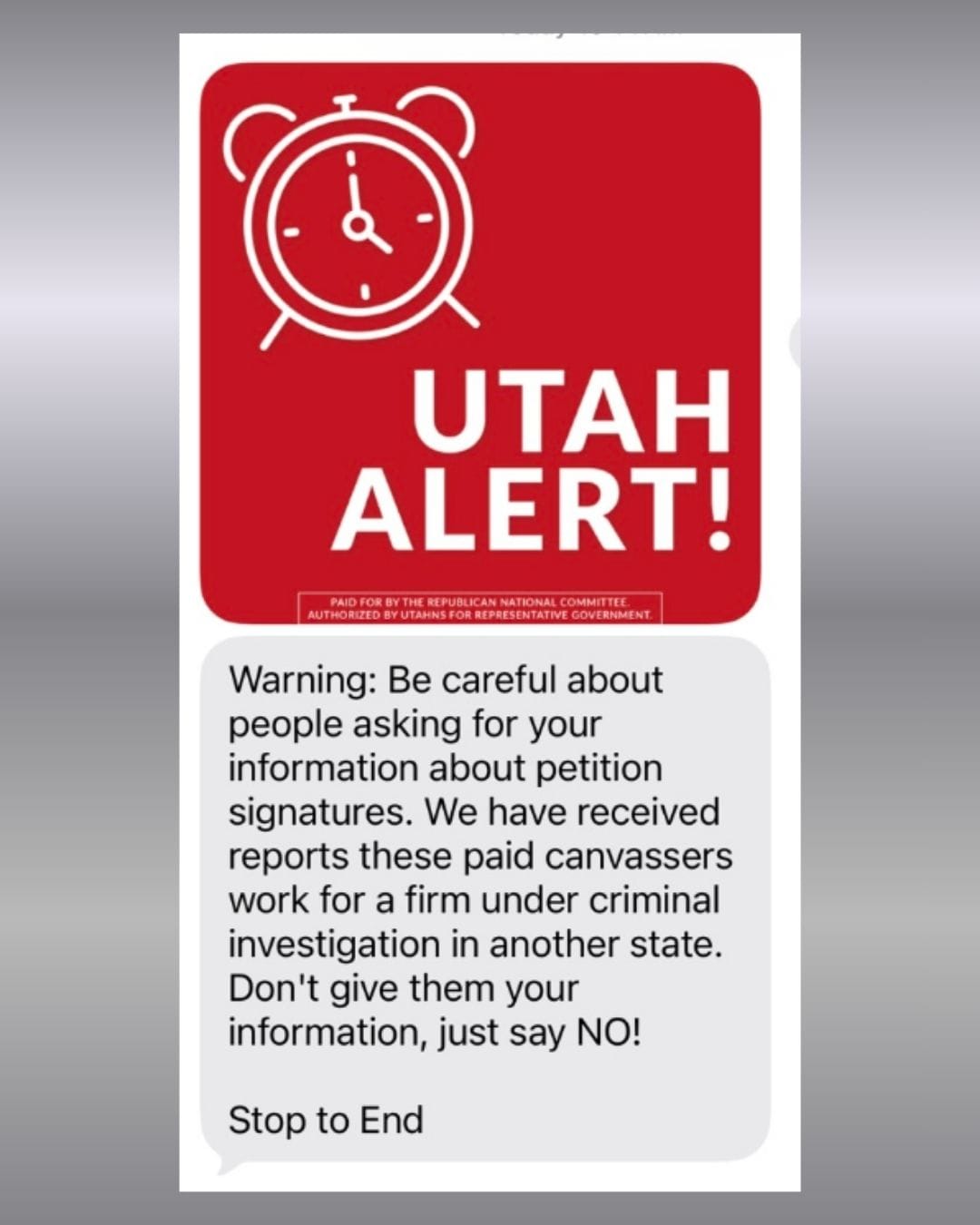
“Warning: Be careful about people asking for your information about petition signatures,” the text message says. “We have received reports these paid canvassers work for a firm under criminal investigation in another state. Don’t give them your information, just say NO!”
Axson did not respond to questions about the text message from Utah Political Watch.