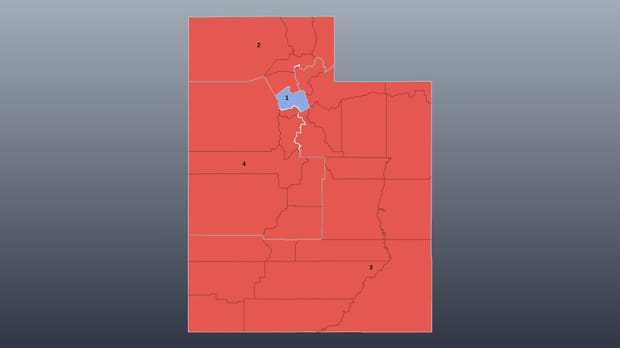
Utah GOP Reps. Celeste Maloy and Burgess Owens, joined by a group of county commissioners and a sheriff, just threw another wrench into the saga over Utah’s congressional map. On Monday, they filed suit in federal court, asking a judge to toss the lines approved by a Utah judge and either hand the pen back to the Legislature or revive the 2021 map.
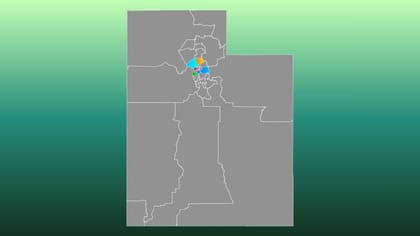
In August, state District Judge Dianna Gibson ruled lawmakers unconstitutionally repealed Prop 4—the 2018 voter-approved anti-gerrymandering law—and tossed the 2021 map. She invited lawmakers and the plaintiffs in that case to submit replacements. The Legislature answered with “Option C.” Gibson called it an “extreme partisan outlier” that flunked Prop 4’s criteria and instead adopted “Map 1,” a plaintiff-submitted plan that happens to create a Democratic-leaning district centered in Salt Lake County.
The new federal lawsuit contends that Gibson overstepped both the U.S. and Utah Constitutions by imposing the map, arguing that a judge can block an unlawful map, but cannot draw or impose a new one for congressional elections because that power belongs to the state legislature or Congress.
The plaintiffs argue that since the map was drawn by the plaintiffs in the lawsuit and not the legislature, voters lost their chance to influence the process through legislative hearings. They also say that the map chosen by Gibson “crams” seventeen counties and part of Utah County into one single congressional district.
“To achieve their federal legislative needs, Plaintiffs who reside in these counties now must compete for attention with triple the number of counties than any other district contains,” the suit contends.
Plaintiffs also say that the map “places many of the fastest growing cities in Utah—including Eagle Mountain, Lehi, Santaquin, and Saratoga Springs—in the same congressional district.”
“By the time the next census is taken and a new map is created in 2030, this district will likely be heavily lopsided compared to other districts,” the suit says. “And because of the influx of new residents, the people residing in that district will likely have their votes diluted.”
Maloy and Owens say that the “rules of the game” for the 2026 congressional elections have been changed at the last minute by a trial court, creating a campaign scramble. They say they prepped for the 2021 map, then “Option C,” and now have to retool yet again—bleeding time and money without knowing where to file or where to show up.
“For example, each Representative will need to spend substantial time and money campaigning in new areas that have not previously been part of their districts,” the suit says. “At this time, the Representatives do not know where to file for office or begin campaigning. Nor do they know where to budget their time. For Representative Maloy, if the current, unconstitutional Map 1 holds, she will be either representing or campaigning in most of Utah’s 29 counties until the election is held in November, should she file to run where she lives.”
In December, Utah lawmakers pushed back the filing date for congressional candidates to March to give them time to appeal Gibson’s decision to the Utah Supreme Court.
Several of the Democratic candidates who are already campaigning for the nomination in the new 1st District ripped the decision by Owens and Maloy to sue.
"This lawsuit is about defending a system where powerful insiders get to lock in results before a single ballot is cast. Utahns spoke clearly when they supported independent standards to prevent partisan gerrymandering. The Utah Constitution protects the standards adopted by voters and the courts are enforcing the law voters passed. This lawsuit is just their latest attempt to stop the will of the people who have clearly said they want fair voting maps and are sick of politicians upending this right to protect their own power," former Democratic Rep. Ben McAdams said in a statement.
State Sen. Kathleen Riebe said it's disappointing that Owens and Maloy can't accept the will of the people.
"Packing the court and their referendum are efforts to circumnavigate a fair and legal process," Riebe said. "And these attacks against our institutions further erodes our trust in our government and that’s a high price to pay for a victory."
State Sen. Nate Blouin said the lawsuit was filed out of fear that the new map could send a Democrat to Congress.
"Utah Republicans want to federalize their attempts to re-gerrymander our state so they can put the new, fair districts in front of Trump’s Supreme Court," Blouin said. "They will fail because they do not have the public on their side.”
The suit also says many local officials have built working relationships with specific members of Congress, and Map 1 disrupts those. For example, Utah County Commissioner Amelia Powers Gardner, who is a plaintiff in the suit, is working on a federal land swap for a pedestrian bridge near Bridal Veil Falls, and Map 1 moves her into a new district, which would force the process to start over.
Lt. Gov. Deidre Henderson, Utah’s chief elections officer, has already said she will use Map 1 implemented by Judge Gibson. The suit asks the court to block Henderson from using that map and to give map drawing authority back to the Legislature. If lawmakers do not draw a new map, they’re asking the court to force the state to use the congressional map approved in 2021. However, that could be difficult since that map has already been ruled unconstitutional because it was the result of the unconstitutional repeal of Prop. 4 by lawmakers.