
With the Feb. 14 deadline looming, the push to repeal Prop. 4, the anti-gerrymandering reform law approved by voters in 2018, is flailing. Utahns for Representative Government (UFRG), the group behind the repeal, is well short on verified signatures—and even further from meeting geographical requirements.
Organizers have just a third of the verified signatures they need by the Feb. 14 deadline. Worse, it hasn’t cleared the bar in a single required state Senate district.
Utah law doesn’t just require a statewide total; there are also signature thresholds in 26 of 29 Senate districts. Miss those, and the measure doesn’t make the ballot no matter the statewide count.
The numbers are brutal.
- Statewide requirement: 140,748 verified signatures. As of now, they’re at roughly 33% with 26 days left.
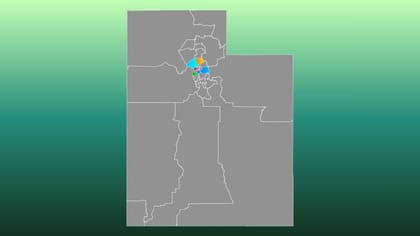
- Geographic requirements: Signatures from 8% of voters in 26 of 29 state Senate districts. They haven’t hit the mark in even one. The closest is SD27 at 84% of the total requirement - still about 900 short.
- Five other districts are above 50%. Everywhere else, they’re under half.
- Ten districts are below 20%. Three are at or below 15%, including SD7—held by Senate President Stuart Adams.
Just to meet the statewide minimum, they need to average more than 3,200 verified signatures per day from here on out. In several districts, the daily pace needs to top 100 verified signatures just to qualify.
Their best day so far was early in the verification process on Dec. 16 with 3,876 verified signatures. The best Senate district that day was SD25 with 461. A month later, SD25 still needs nearly 60 verified signatures per day to qualify.
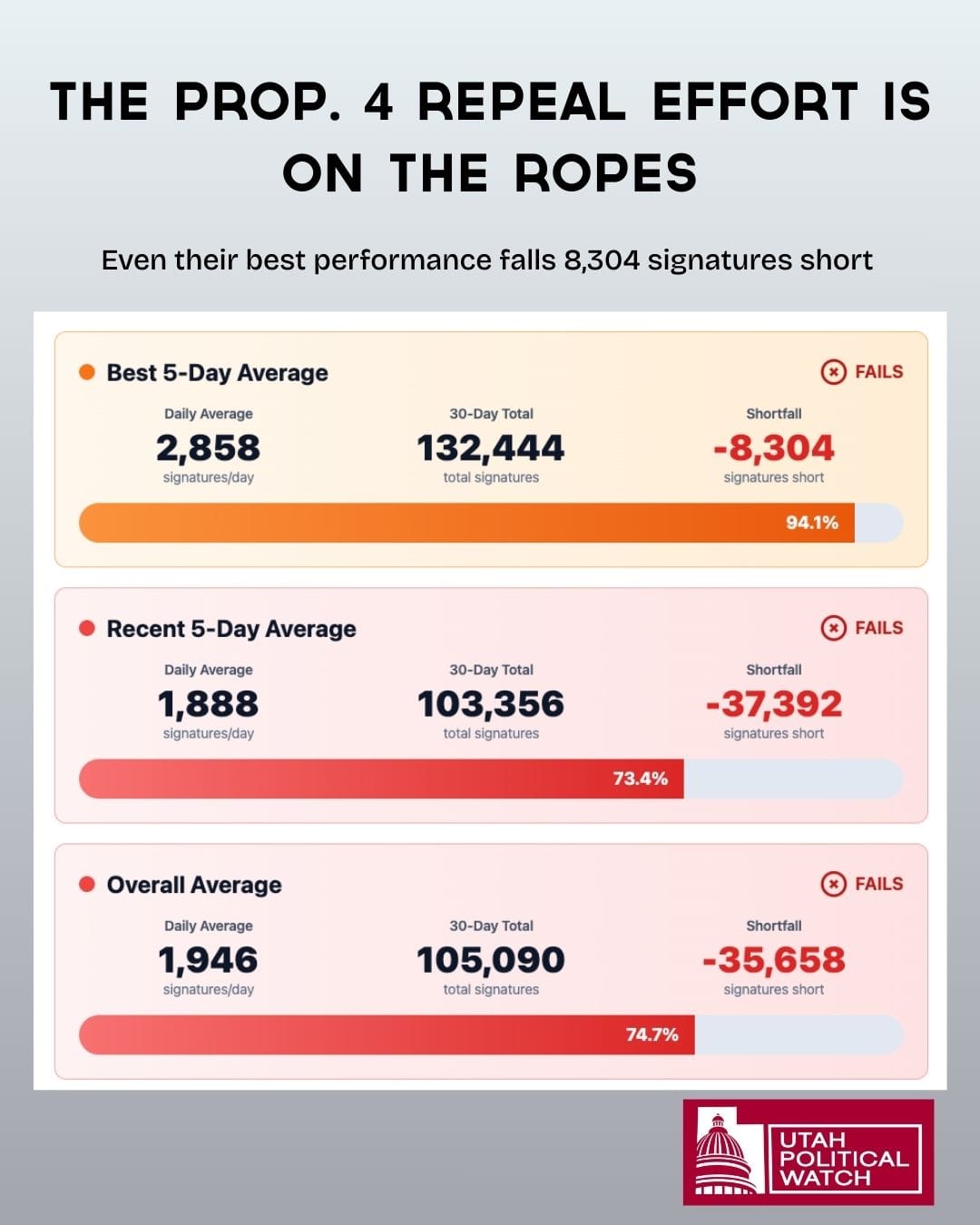
The best five-day average so far for signature verification was Dec. 15-19, when they averaged about 2,858 per day. Even if they matched that for the next month, they’d still fall approximately 8,300 signatures short of the statewide requirement. They need to outperform their peak performance by nearly 10% for four straight weeks just to squeak by.
Momentum is sliding, not climbing. The recent five-day average is down 34% from peak. The best 10-day average—2,124 per day—is still 32% below what’s needed.
Last year’s HB267 referendum shows how far behind this effort is.
HB267 banned public sector employees from collectively bargaining for wages and benefits, effectively neutering public employee labor unions. After the GOP supermajority in the legislature rammed it through during the 2025 session, labor groups mobilized a referendum for the 2026 ballot. Lawmakers repealed HB267 in a special session late last year rather than give angry voters a reason to show up in November.
While referendum rules differ slightly from initiatives, the statewide signature goal is the same.
In just 23 days, HB267 organizers had 251,262 signatures verified—nearly double the statewide requirement—averaging 10,924 per day. Organizers say they submitted more than 320,000 signatures before officials stopped counting.
By contrast, the Prop. 4 repeal has averaged about 1,946 per day over 24 days, which is 81% slower than the referendum.
The HB267 repeal collected signatures at 5.6x the rate as the Prop. 4 repeal and almost certainly hit the district requirements in 26 Senate districts. The repeal hasn’t met the requirement in even one district.
Even more damning, UFRG has spent $4.3 million for paid petition gatherers, according to financial disclosures, which is more than $92 per signature so far.
Protect Utah Workers, the group that organized the HB267 repeal, spent just over $2.7 million, just $10.75 per signature.
Protect Workers, the group that organized the repeal, spent $2.7 million to collect 251,262 signatures at $10.75 each. UFRG has spent 61% more for 81% fewer signatures at this point.
Even more damning is the massive financial backing for the Prop. 4 repeal. UFRG has spent $4.3 million for paid petition gatherers, according to financial disclosures - which is more than $92 per signature so far. All of UFRG’s money has come from just one donor. Securing American Greatness, a dark money group aligned with President Donald Trump’s political operation.
By comparison, Protect Utah Workers, the group that organized the HB267 repeal, spent just over $2.7 million, an average of about $11 per signature.